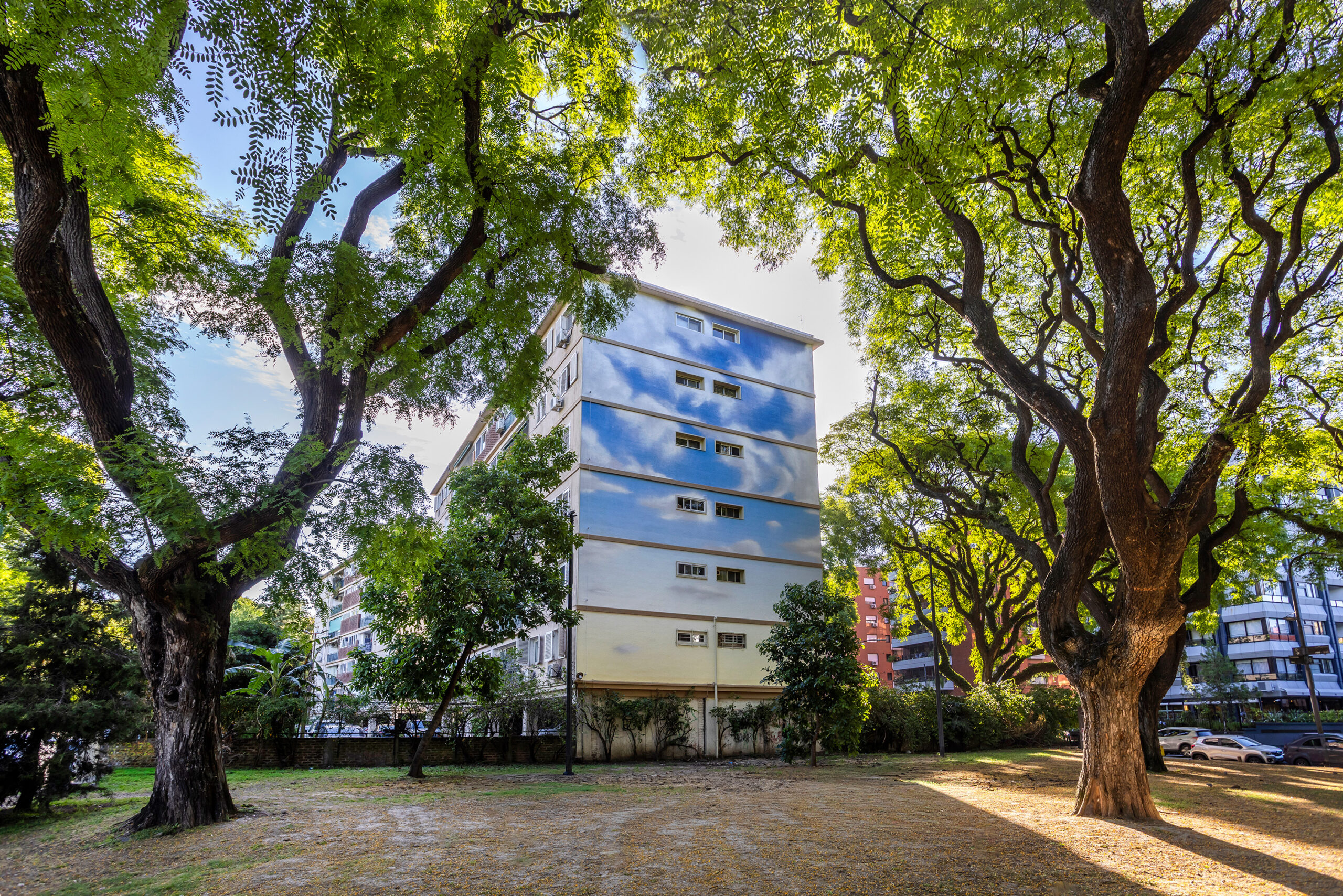
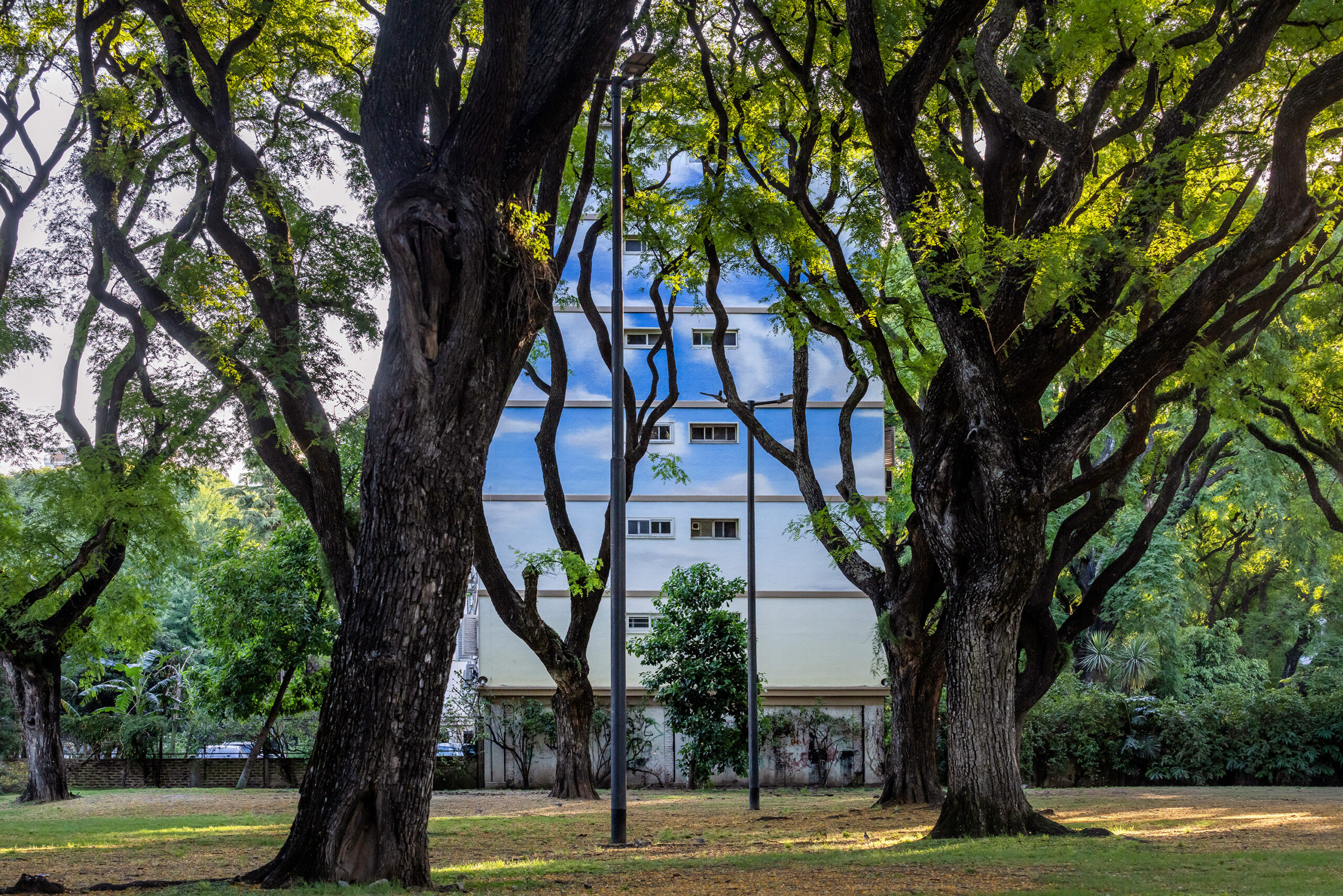
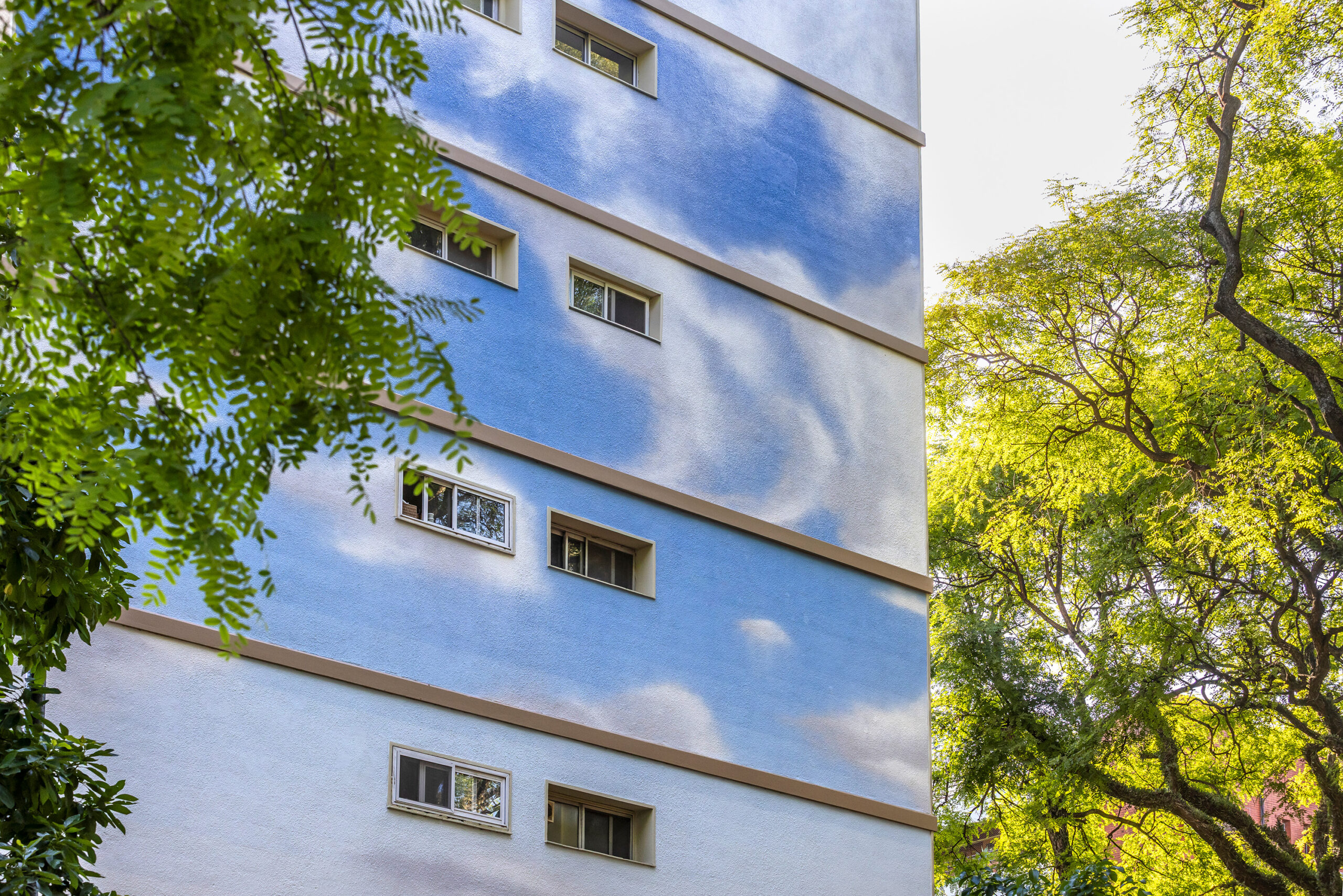
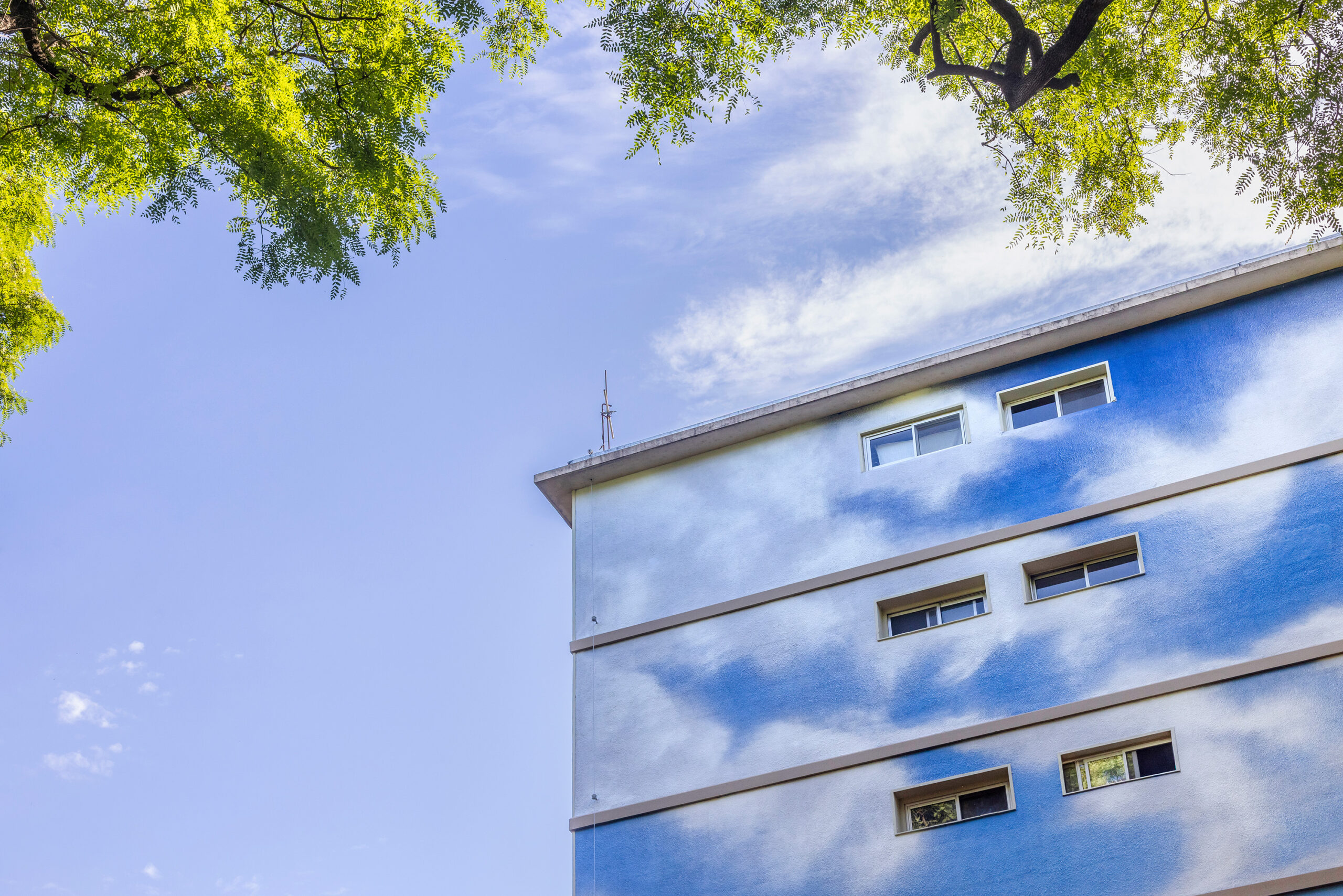
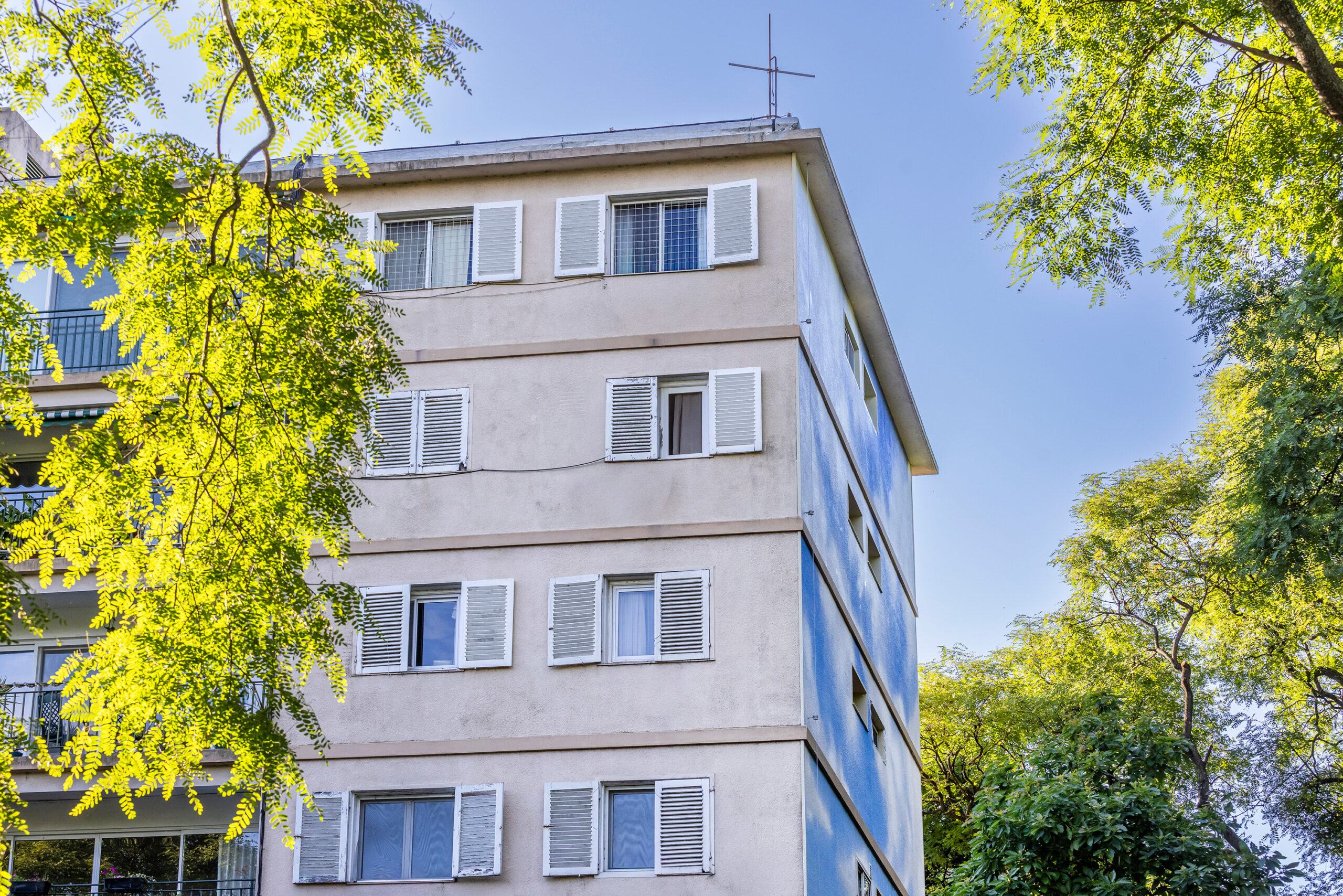
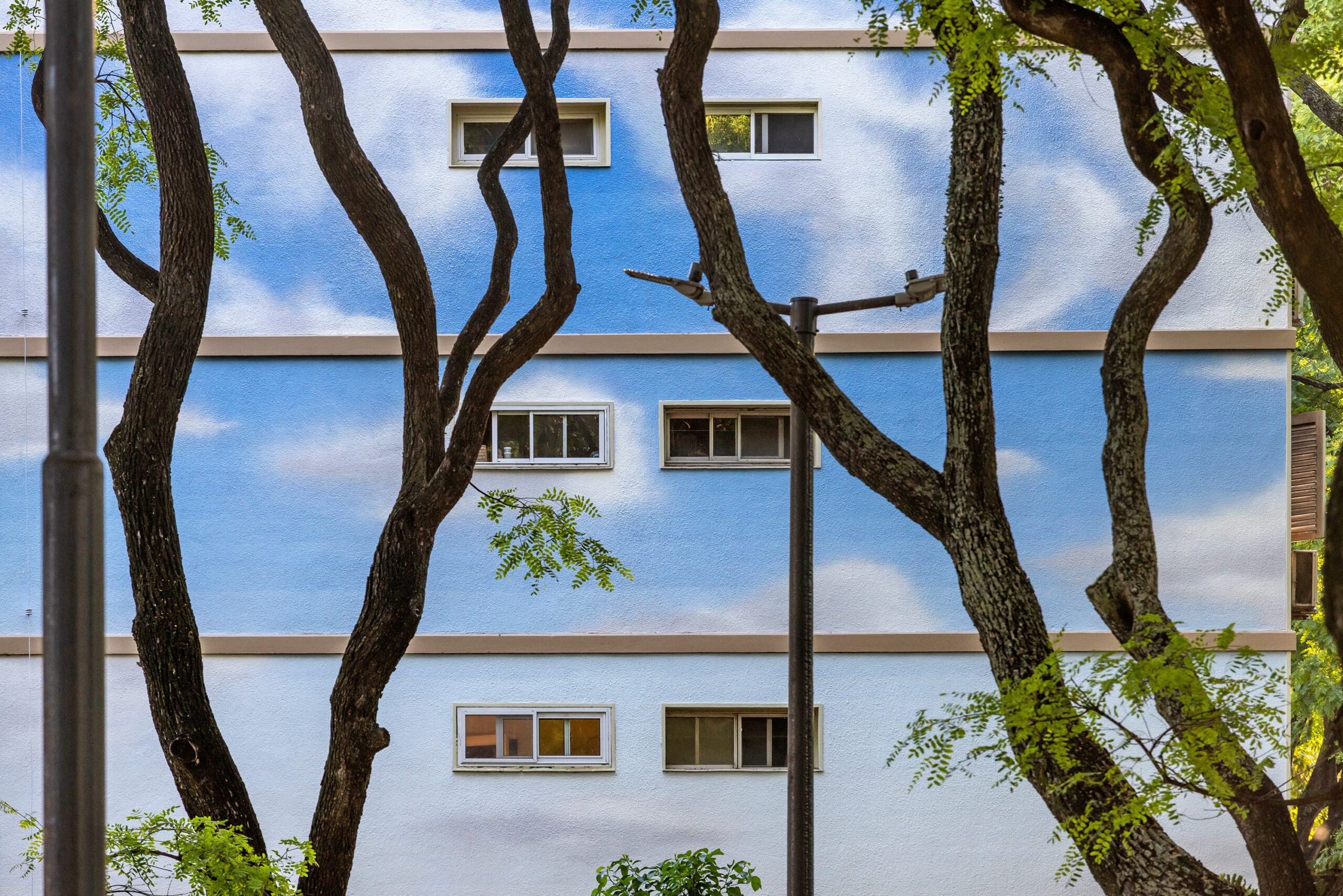
“Cielos” series
Buenos Aires, Argentina 🇦🇷
Independent project
Acrylic paint on concrete wall
11,5 x 20 m
2025
This project was made with the support of Estudio Puente, Sinteplast and Umbral Cultura
Photos by Muerta de Arte
•
“Mural and anti-mural”, conversations between Andrés Goldberg and Jorge Pomar.
AG: A new sky appears in a new Buenos Aires neighborhood. It joins other large murals you’ve been making for some time now, which stand out for the simplicity of the form, the palette of blues in gradient, the relationship with the surroundings, the marks of the structure operating as “separators” between different panels. The works always seem to take two directions that don’t always go in the same sense, but somehow they converse, or are linked in a game of tacit cross-references. On the one hand, the contemplative search is clear. The figure is a sky, and from there the idea of creating a space in tune with the surroundings is born. On the other hand, the works play with a more conceptual dimension, which is that of reclaiming a certain abstraction of painting. The motif of the sky then appears as secondary. It’s not so much about what is represented, but rather about the link that abstraction establishes with that environment, the projections that can appear within that landscape.
JP: The idea of creating a space of calm with the surroundings interests me when the time of day and the weather propose a dialogue between the work and the context, when the edges become confused and lose definition. On the other hand, the projections that can appear within that landscape are also a fundamental part of this series. The sky is always a place of contemplation where the morphology of events proposes an infinite series of mutable abstractions, in constant change. From there a range of subjectivities unfolds. I’m seeing a tree while you see a dragon, a guitar, or a face. In this sense I see a very rich playing field to develop from painting.
AG: This dimension, at once abstract and contemplative, made me think of a series by Alfred Stieglitz, in which the father of modern photography made a large series of “skies and clouds” that he photographed over ten years and called Equivalent. The series plays with the muteness of photography, the fact that we always photograph concrete things, but we never see those things; rather, through the power of framing and composition, we always lean toward a meaning that somehow transcends the visible. But the question is where that meaning comes from and how it transforms the material of the image. It’s a long work on photographic representation and it seems to me it can be used as a trigger for a key question in your work: what is the meaning of that sky, how does it change with the framing (that is, with the environment), and how can it relate to your other works.
JP: My head generates by default the links that can be created between the works of the Cielos series spread across the city. Sometimes I think of the connections in an underground way, like energy cables between work and work. Sometimes I imagine those cables flying through the air. I wonder how these skies are conversing with each other at this very moment, whether all together they can generate a great image, a mantle of skies, to propose a possible Buenos Aires vision of our permanent blue roof. I wonder, if we place all these skies in chronological order side by side, what image forms? Does it resemble a prism, a sticker album, a kaleidoscope? I’m interested first in thinking about the support, investigating the surface and its context. What texture the wall has, what the windows are like, how many levels it has, what position it has relative to the sun, whether it is a completely flat plane or whether there are elements of the architecture that form modules you can play with (slabs, beams, poorly patched holes, vestiges of the past). My first approach is obsessive observation. These questions are what will propose a broken image of the sky, shifted away from a linear observation to generate a different image and to look at painting in vignette format, as if it were a comic. This is a primary reference from my childhood, a fragmented way of looking.
AG: These two lines that intersect in your work also seem to me to be the knot of a problem. Where should the work go? What should happen with those clouds, that is, with the figurative dimension, simple but too present? How many more skies can such large walls support without the motif changing? In general terms, I wonder how from the experimental side of your work the idea of an “other muralism” can continue to develop without recreating a new figuration.
JP: What I ask myself is how to continue searching for images to propose on large surfaces that revolve around a recurring question in my search: what is behind the walls? Therefore, also behind the sky. I always think of that key moment in The Truman Show where the protagonist sets sail in a boat and reaches the border of the great fictitious stage that is his life: the boat crashes into the limit of the set. Then the horizon becomes fragile, tangible, and passable. In this sense, I think about the layers we build and about the surfaces of the places we inhabit, suspecting that there is always something more and the question becomes something a bit more esoteric. Layers of paint, fine plaster, rough plaster, bricks, air, water pipes, electrical cables, air again, bricks, rough plaster, fine plaster, to name an order of the architectural sandwich. And then, what else is there? In this curious pursuit to know what lies beyond, I find myself working with what I have closer, above all with what is most visible and most present in my urban everyday life: bricks, cement, skies, and clouds. I look at these elements every day, I observe them up close and from afar with a photographic gaze, I go looking for them by bike with a camera, I get excited about the random discoveries the city proposes, as long as I am available and looking a little upward. So, where should the work go? I think it should go toward an increasingly complex collage of textures. I’m going to share the image of a wall I saw yesterday on a Berlin Tumblr. What is painted and what isn’t painted? I think the Cielos series can lead to a fiction that is evident, like for example a broken sky, with patches of putty or roofing membrane. I want to repair the cracks and the dampness of the sky. I want to propose errors on that beautiful blue texture we see every day. I want to see the holes we are not seeing with the naked eye.
AG: There is an idea we talked about which is that of the anti-mural, which would go against advertising and against images that seek to monopolize the gaze of the urban landscape. I understand the need for this turn, but I also wonder if that is truly an antagonistic element, an anti. Fundamentally because the mural always solicits the gaze of the passerby and comes to cover an urban plane. In this last case, it surprised me that in some way it transmutes it; the windows give the wall an almost human aspect, it seems that the wall is looking at us. But again, I don’t recognize that transmutation as an anti-mural, but as another way of soliciting the passerby who may come to look at the work. That establishes another relationship with the architecture of the building: it not only covers it but also transforms it. This element is less present in the other sky-walls. I also wanted to know whether this is a sought effect or an accident of experimentation. How can one continue experimenting to think about this relationship with painting so that it is not only about covering what is already there, but also transmuting it and exposing it at the same time?
JP: It is neither a sought effect nor an accident of experimentation. The difference with the other supports is the presence of windows and existing architectural decisions. In other words, it is not a completely flat surface, unlike the other works which are flatter. The building looks at us because these windows are positioned in front of the sky, since the sky always functions as a background, the last layer of the visible, at least within our gaze and our way of perceiving the landscape. So any existing or fictional object placed on this background will stand out and come forward. I think it looks at us because the work makes these existing decisions appear. Before painting it, the building didn’t look at us (and we passersby didn’t look at it either). Now that there is a work, other things happen. The edges acquire another connotation, the windows another prominence; where there is a patch there is now a different texture that protrudes. The skin of the building begins to reveal its flaws, protuberances, objects, textures, fissures, dirt, etc. Then the gaze begins to perceive things that it did not necessarily look at before. If I transfer this gaze to other planes in the city, the sensitivity becomes a bit sharper and suddenly, for example, a boarded-up wall begins to have another value. The same can happen with a party wall or a façade painted entirely in a solid blue. Is it a work? On sunny days with a lot of light, could it become invisible?
AG: There is a delicate balance between what the work “hides” and what the work “makes appear.” Two ideas of art that I find interesting to present theoretically come into conflict here. One moves toward the idea of art as representation, mimesis, maintaining the illusion. I immediately think of the myths that founded the history of art, where what is at stake between Zeuxis and Parrhasios is the illusory quality of the work, the trompe-l’oeil. The other has to do with the conceptuality of art, that is, with the capacity of art to break representation, but at the same time to appropriate it and leave it available for new artistic uses. Between these two poles I think every work oscillates if it does not want to be purely decorative. To be more concrete, I think the skies have a side where illusion appears, and another side that proposes a game with the architecture that serves as its base of inscription. There is a balance between making something that makes more aesthetic what is gray, cumbersome, imposing, and that in a city like Buenos Aires grows under a purely developmentalist logic. And another pole that precisely proposes not to hide it but— I would say— to exacerbate it. To exacerbate the architecture with a soft but insistent gesture. We are between concealment and exasperation. However, I wonder which pole is more present in each work, how that balance forms between the idea of the work, its more conceptual side and its more aesthetic side. I believe art can never separate itself from that sensitive pole, but I question how that process takes place in your work, which part you feel is more finished and which part still needs to be developed further.
JP: I find a fascination in walls that have patches, unfinished plaster, paths of gypsum or filler covering cracks, surfaces repeatedly bricked up, sometimes with common bricks mixed with hollow bricks, walls that show signs of the past in a process of constant transformation. I see an ordering of events that things go through in order to never become something finished, with a beginning but no end. I see a richness in that in-between, an undefined moment. Many works installed in public spaces, once finished, no longer belong to the artist, nor to the property owners, nor to the government, nor to anyone in particular. There is no clear person responsible in relation to what happens next. It is the city that (in)voluntarily appropriates that place. There, organic failures without solution appear, unexpected phenomena, messages of love, insults directed at a soccer team, anonymous signatures, stains from the passage of time, etc. I love when these things happen to public works because they are all surprises; they cannot be anticipated or programmed. It is a state of constant impermanence. In March 2025 I finished a 300 m² work in the courtyard of a primary school. Two weeks ago a friend sent me a photo of a corner where the students had been leaving names, drawings, dates, marks, and illegible messages. For me, those gestures are the most beautiful becoming. Anonymity, naivety, and surprise take over the playing field. The passage of time ends up being the most relevant author. I think of the work “El baño” by Roberto Plate exhibited at the Di Tella in 1968 and later censored by the government of Onganía. The social becomes an artistic fact.
AG: There are two artists who seem key to me for thinking about the work you’re doing. One flirts with the decorative and the other with the antagonistic. The first is Daniel Buren. The other, Gordon Matta-Clark. Buren has that point similar to your work where the motif is repetitive. But here the logic is one of saturation; Buren’s lines are so repetitive that they overflow the frame and literally leave the exhibition space, they overlap with the architecture, they bother the other works (and they really bother—one must remember that in 1971 he got himself expelled from a group exhibition at the Guggenheim in New York because his works covered others and especially the view of the famous central hall, which proved unbearable). At certain moments, Buren invents new labels for other works in the place where he exhibits, creating a series of elements that come to decompose the order of art, perhaps to blow it up from the inside. On the other hand, Matta-Clark works with the idea of the “anti.” He proposes interventions that are abrupt, colossal, photographic (since they are conceived in terms of their reproducibility through sublime photomontages) and aim to expose a fissure that the works are already virtually working with. For example, the house in Splitting that he cuts in half is a house that had been expropriated from its owners because of real estate speculation, a process seen daily in Buenos Aires and that only seems to grow. In this way, the house is already virtually fissured before the artist’s action. One is softer, the other more bellicose. But both are extremely original and also strategic with the use of the material they have at their disposal. Your strategy goes through muralism. But for me muralism is that in your work—a strategy, a way of appropriating the wall in order to expose the wall as a social signifier, the virtual elements that fissure it. Perhaps there are two points there that could be developed. On the one hand, the archival dimension: the photos, the images, the videos that unite the works and make of all the walls, one wall. On the other hand, the history of those spaces and the layers that are already present that are also layers of rotten paint. Sometimes I wonder if your work shouldn’t leave more space for these other layers, if the colors couldn’t come to complete rather than cover. I imagine your skies as circuit breakers that activate the space that surrounds them. But I also wonder how this space can gently alter it and resignify it. The idea of sky is interesting because it makes a kind of extension of the space, lengthening what is there. But what would happen if you worked with pure colors, without clouds. I think of the work of the Swiss concrete painters, like Stéphane Dafflon, whom we have already talked about. For them, panels of pure color do not represent anything, but rather are a concrete material, like the bricks of a wall or cement.
JP: One possibility would be to add-subtract, instead of only adding. Adding is a vice, sometimes a mechanical action, especially for painting addicts like us who work by superimposing layers. For example, it occurs to me to use pure colors to generate a very subtle background made of many layers of material and then chip away the first skin of plaster, proposing the shape of a cloud and thus revealing the interior of the wall. In this sense, there are two public works installed in Poland that resonate in my head made by a Ukrainian artist, Vova Vorotniov. In the first he uses two colors on the side of a four-story building. The gesture lies in painting a rectangular orange frame around the perimeter of the support, as if it were a photographic frame. Inside this frame, he replicates in black the counterform of an organic stain that already exists on the surface as a result of repairs, constructions, destructions, and information belonging to the passage of time. This frame indicates where to look in order to highlight the roughness of the surface. Above all it proposes that we think about the history of those textures and whether there ever existed an extension of the building that is no longer there today. The other work proposes a gesture of subtraction by breaking with a pick and hammer the plaster layer to reveal the internal pattern of bricks. It is not a random shape; rather, the drawing it designs is precisely a pick and a hammer, first in representation of the only tools used in the project, and secondly in reference to the communist symbol of the sickle and hammer. These works have nothing to do with muralism nor with the proposals we see daily in cities that are linked more to an advertising code, but rather they come much closer to the language proposed by Matta-Clark. On the other hand, I think of the work Tapiar Buenos Aires by Nacho Unrrein, who also works with a similar language. The work is a ?sculpture? at 1:1 scale where he shows a wall of hollow bricks but in a 2D format, that is, flat and planar, without depth, as if it were a sticker. One way I learned to observe the city is related to this two-dimensional gaze, where I see flat planes and giant interchangeable textures like collectible cards.